
Mastering AI-Powered Analytics Tools for a 15% Sales Boost in 2026: A 3-Month Implementation Guide
In today’s hyper-competitive market, businesses are constantly seeking innovative ways to gain an edge. The promise of a 15% sales boost isn’t just a dream; it’s an achievable reality through the strategic deployment of AI analytics sales boost technologies. Artificial Intelligence (AI) and advanced analytics are no longer futuristic concepts; they are essential tools transforming how businesses understand their customers, optimize operations, and, most importantly, drive sales. This comprehensive guide will walk you through a practical 3-month implementation plan to harness AI-powered analytics and achieve significant sales growth by 2026.
The journey to a 15% sales boost begins with understanding the profound impact AI can have on your sales pipeline. From predictive lead scoring to personalized customer experiences and dynamic pricing, AI offers capabilities that traditional analytics simply cannot match. By automating data analysis, identifying hidden patterns, and providing actionable insights, AI empowers sales teams to work smarter, not just harder. Our focus here is on a structured, actionable plan designed for tangible results within a challenging yet realistic timeframe.
The Transformative Power of AI Analytics for Sales Growth
Before diving into the implementation roadmap, it’s crucial to grasp why AI analytics sales boost initiatives are so impactful. AI excels at processing vast amounts of data at speeds and scales impossible for humans. This capability translates directly into enhanced sales performance through several key mechanisms:
- Predictive Lead Scoring: AI algorithms can analyze historical data to identify the characteristics of high-value leads, predicting which prospects are most likely to convert. This allows sales teams to prioritize their efforts, focusing on the hottest leads and improving conversion rates.
- Personalized Customer Experiences: By analyzing customer behavior, preferences, and purchase history, AI enables businesses to deliver highly personalized marketing messages, product recommendations, and service interactions. This level of personalization significantly enhances customer engagement and loyalty, directly impacting sales.
- Optimized Pricing Strategies: AI can continuously monitor market conditions, competitor pricing, and customer demand to recommend optimal pricing strategies. Dynamic pricing, powered by AI, can maximize revenue and profit margins by adjusting prices in real-time.
- Sales Forecasting Accuracy: Traditional sales forecasting often relies on historical trends and human intuition. AI-powered forecasting incorporates a multitude of variables, including economic indicators, seasonality, and promotional impacts, leading to significantly more accurate predictions and better resource allocation.
- Churn Prediction and Retention: Identifying customers at risk of churning allows businesses to proactively intervene with targeted retention strategies. AI can predict churn likelihood, helping companies retain valuable customers and protect their recurring revenue streams.
- Automated Sales Tasks: AI can automate routine sales tasks such as data entry, scheduling, and initial customer outreach, freeing up sales representatives to focus on relationship building and closing deals.
These capabilities collectively contribute to a more efficient, effective, and customer-centric sales operation, paving the way for that coveted 15% sales boost. The key is not just acquiring the tools, but strategically integrating them into your existing workflows.
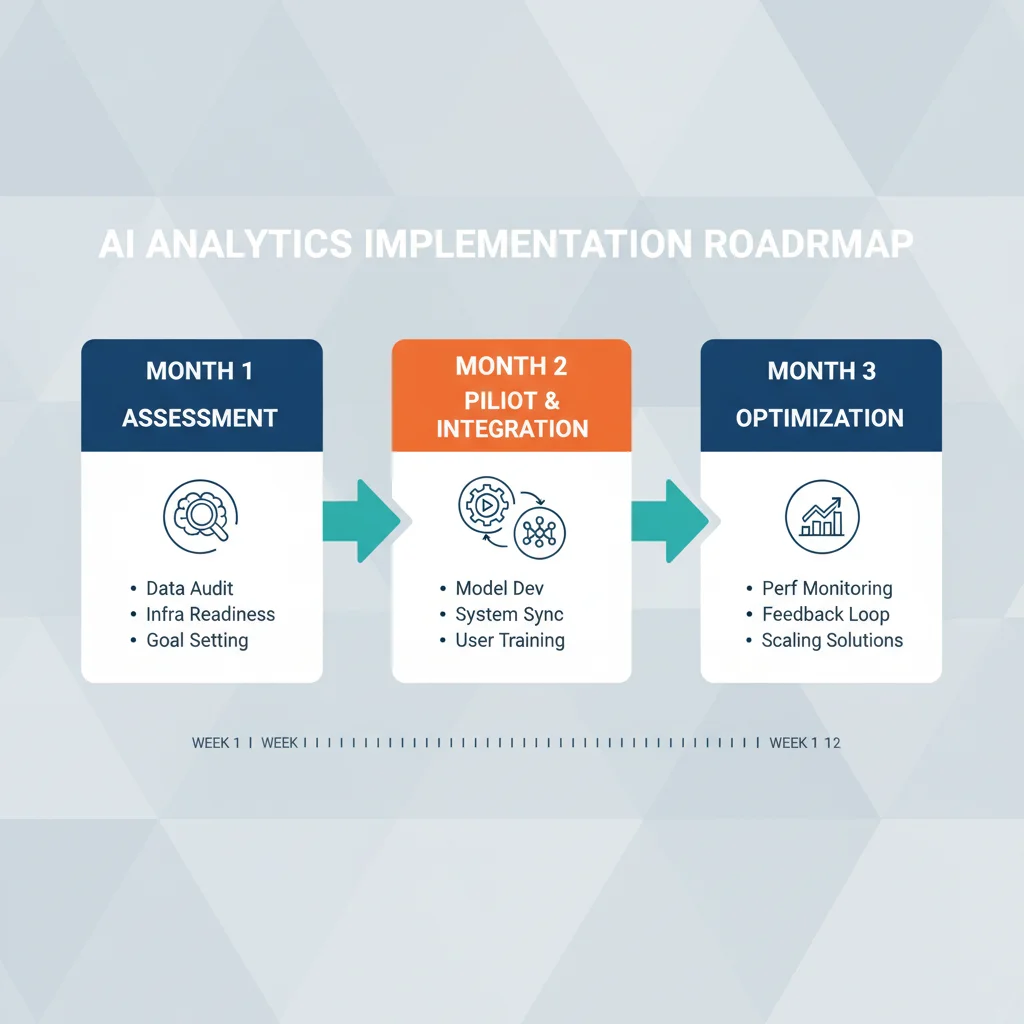
The 3-Month Roadmap to a 15% Sales Boost with AI Analytics
Achieving a substantial AI analytics sales boost within a relatively short timeframe requires a structured and disciplined approach. Our 3-month plan is divided into three distinct phases, each with specific objectives and deliverables.
Month 1: Assessment, Data Foundation, and Tool Selection
The first month is all about laying a solid foundation. Without a clear understanding of your current state, data landscape, and desired outcomes, any AI initiative is likely to falter.
Week 1-2: Current State Assessment and Goal Definition
- Define Clear Sales Objectives: Beyond the 15% target, what specific sales metrics do you want to improve? (e.g., conversion rates, average deal size, customer lifetime value, lead-to-opportunity ratio). Quantify these goals.
- Audit Existing Sales Processes: Document your current sales funnel, from lead generation to post-sale support. Identify bottlenecks, inefficiencies, and areas where data is underutilized.
- Identify Key Stakeholders: Engage sales leadership, marketing, IT, and data science teams. Their buy-in and collaboration are critical for success.
- Assess Data Readiness: Evaluate your current data infrastructure. Where is your sales data stored? What is its quality? Are there disparate data sources that need integration?
Week 3-4: Data Preparation and AI Tool Exploration
- Data Cleaning and Integration: This is a critical step. AI models are only as good as the data they’re fed. Clean, standardize, and integrate data from all relevant sources (CRM, ERP, marketing automation, website analytics, social media). This might involve setting up data pipelines and ETL (Extract, Transform, Load) processes.
- Identify Key Data Points: Determine which data points are most relevant for achieving your defined sales objectives. This could include customer demographics, interaction history, purchase patterns, web behavior, and more.
- Research AI Analytics Tools: Explore the market for AI-powered sales analytics platforms. Consider factors like ease of integration with existing systems, scalability, features (predictive modeling, natural language processing, prescriptive analytics), vendor support, and pricing. Popular choices might include Salesforce Einstein, Adobe Sensei, HubSpot AI tools, or specialized platforms like DataRobot, H2O.ai, or custom-built solutions.
- Pilot Project Definition: Select a small, manageable pilot project for the next phase. This could be optimizing lead scoring for a specific product line or personalizing email campaigns for a segment of customers.
By the end of Month 1, you should have a clear understanding of your sales challenges, a clean and integrated dataset, and a shortlist of potential AI analytics tools, along with a defined pilot project.

Month 2: Pilot Implementation and Initial Integration
Month 2 is about putting theory into practice, running your pilot project, and beginning the broader integration of your chosen AI analytics sales boost solution.
Week 5-6: Tool Selection and Pilot Setup
- Final Tool Selection: Based on your research and specific needs, make a definitive choice for your AI analytics platform. Negotiate contracts and begin onboarding.
- Pilot Data Feed and Model Training: Connect your clean data to the chosen AI platform. For your pilot project, begin training the AI model. For example, if your pilot is lead scoring, feed the model historical lead data with conversion outcomes.
- Initial Configuration and Customization: Configure the tool to align with your sales workflows. This might involve setting up dashboards, alerts, and reporting mechanisms relevant to your pilot project.
- Team Training (Pilot Group): Train the small group of sales or marketing professionals involved in the pilot project. Ensure they understand how to interact with the AI insights and integrate them into their daily tasks.
Week 7-8: Pilot Execution, Monitoring, and Feedback
- Execute Pilot Project: Launch the pilot. For instance, if it’s predictive lead scoring, sales reps start prioritizing leads based on AI scores. If it’s personalized campaigns, launch the AI-driven campaigns.
- Monitor Performance: Closely track the key metrics defined for your pilot. Compare performance against a control group or historical benchmarks.
- Gather Feedback: Collect qualitative feedback from the pilot team. What’s working well? What are the challenges? Are the insights actionable?
- Iterate and Refine: Use the feedback and performance data to make immediate adjustments to the AI model, tool configuration, or sales process. AI is iterative; continuous refinement is key.
By the end of Month 2, you should have a successfully executed pilot project, validated the potential of your chosen AI tool, and gathered crucial insights for broader deployment.
Month 3: Full-Scale Integration, Optimization, and Scaling
The final month focuses on expanding the successful pilot, integrating AI across relevant sales functions, and establishing a culture of continuous optimization to sustain the AI analytics sales boost.
Week 9-10: Broader Integration and Training
- Phased Rollout: Begin integrating the AI analytics tool into other relevant sales and marketing functions. This could involve expanding predictive lead scoring to all sales teams, implementing AI-driven product recommendations on your e-commerce site, or using AI for churn prediction across your customer base.
- Comprehensive Team Training: Conduct broader training sessions for all affected sales, marketing, and customer service teams. Emphasize how AI insights complement their roles and improve outcomes. Provide resources and ongoing support.
- Establish Reporting and Dashboards: Create comprehensive dashboards that provide real-time insights into sales performance driven by AI. Ensure these are accessible and understandable for all stakeholders.
- Automate Workflows: Integrate AI insights directly into CRM and marketing automation platforms. For example, automatically trigger follow-up emails for high-scoring leads or create tasks for sales reps based on churn predictions.
Week 11-12: Optimization, Performance Measurement, and Future Planning
- Continuous Model Optimization: AI models are not set-and-forget. Continuously monitor their accuracy and relevance. Retrain models with new data periodically to ensure they remain effective.
- Measure ROI and Sales Impact: Rigorously measure the impact of AI on your key sales metrics. Quantify the 15% sales boost (or progress towards it) by comparing performance against baseline data and control groups. Calculate the return on investment (ROI) of your AI initiatives.
- Feedback Loop and Improvement: Establish a continuous feedback loop from sales teams to data scientists. Encourage suggestions for new AI applications or improvements to existing ones.
- Scale and Expand: Based on initial successes, identify opportunities to further scale your AI analytics capabilities. Explore additional use cases, integrate more data sources, or adopt more advanced AI techniques (e.g., natural language generation for sales reports).
- Documentation and Best Practices: Document your implementation process, lessons learned, and best practices to ensure future success and knowledge transfer.
By the end of Month 3, you should have a fully integrated AI analytics system actively contributing to your sales goals, with a clear path towards achieving and exceeding your 15% sales boost by 2026.
Key Challenges and How to Overcome Them
While the potential for an AI analytics sales boost is immense, businesses often encounter challenges during implementation. Anticipating these and preparing strategies to overcome them is crucial.
- Data Quality and Availability: Poor data quality (inaccurate, incomplete, inconsistent) is the biggest hurdle.
- Solution: Invest in data governance, data cleaning tools, and robust data integration strategies from day one. Emphasize data quality as a continuous process.
- Lack of Skilled Personnel: Developing, deploying, and maintaining AI models requires specialized skills (data scientists, AI engineers).
- Solution: Invest in training existing staff, hire specialized talent, or leverage AI-as-a-Service (AIaaS) platforms and external consultants to bridge the skill gap.
- Integration Complexity: Integrating new AI tools with legacy systems can be complex and time-consuming.
- Solution: Prioritize tools with open APIs and strong integration capabilities. Plan for phased integration and consider middleware solutions.
- Resistance to Change: Sales teams might be hesitant to adopt new technologies or trust AI-driven insights over their intuition.
- Solution: Emphasize the ‘AI-assisted’ rather than ‘AI-replaced’ approach. Demonstrate tangible benefits through pilot projects, provide thorough training, and highlight how AI empowers them to achieve more. Secure leadership buy-in and champion the change.
- Ethical Concerns and Bias: AI models can inherit biases from the data they are trained on, leading to unfair or discriminatory outcomes.
- Solution: Implement rigorous data auditing, ensure diverse and representative datasets, and regularly monitor AI model outputs for bias. Prioritize ethical AI development and deployment.
- Measuring ROI: Clearly attributing sales increases directly to AI can be challenging.
- Solution: Establish clear baseline metrics before implementation. Use A/B testing, control groups, and robust attribution models to quantify the impact of AI initiatives.
Real-World Examples of AI Analytics Driving Sales
Numerous companies across various sectors have successfully leveraged AI analytics sales boost strategies to achieve remarkable growth. These examples underscore the practical application and tangible benefits of AI:
- E-commerce Giants (e.g., Amazon, Netflix): These companies are masters of AI-powered recommendation engines. By analyzing browsing history, purchase patterns, and even viewing habits, AI suggests products or content that customers are highly likely to engage with, significantly driving sales and retention.
- Retailers (e.g., Starbucks, Target): AI is used for personalized marketing campaigns, dynamic pricing based on local demand and inventory, and optimized store layouts. Starbucks uses AI to personalize offers through its mobile app, leading to increased customer engagement and repeat purchases.
- Financial Services (e.g., Banks, Fintech): AI helps banks identify potential customers for specific financial products, detect fraudulent transactions, and personalize customer service through chatbots. This leads to better lead qualification and reduced operational costs.
- B2B Software Companies: Many SaaS companies use AI for predictive lead scoring, identifying which trial users are most likely to convert to paid subscriptions, and personalizing outreach to enterprise clients. This optimizes sales team efficiency and improves conversion rates.
- Automotive Industry: Manufacturers use AI to analyze customer preferences for car features, predict demand for new models, and optimize pricing strategies across different regions. Dealerships use AI for targeted marketing and customer retention programs.
These examples demonstrate that regardless of industry, the principles of leveraging AI to understand customers better, predict future behavior, and optimize sales processes remain consistent and highly effective.
The Future of Sales: Continuous AI Evolution
The 15% sales boost by 2026 is just the beginning. The field of AI is constantly evolving, and so too will its applications in sales. Businesses that embed a culture of continuous learning and adaptation regarding AI will be best positioned for sustained growth. Future trends to watch include:
- Generative AI for Sales Content: AI that can generate personalized sales emails, product descriptions, and even presentation slides, dramatically increasing sales team productivity.
- Advanced Conversational AI: More sophisticated chatbots and voice assistants that can handle complex sales inquiries, qualify leads, and even close deals autonomously.
- Hyper-Personalization at Scale: AI will enable even deeper levels of personalization, creating unique customer journeys for every individual, influencing everything from product development to post-purchase support.
- Ethical AI and Trust: As AI becomes more pervasive, ensuring ethical use, transparency, and building customer trust will be paramount for long-term success.
Embracing these advancements and integrating them into your strategy will ensure that your AI analytics sales boost continues to grow beyond 2026.
Conclusion: Your Path to a 15% Sales Boost by 2026
Achieving a 15% sales boost by 2026 through AI-powered analytics is an ambitious yet entirely attainable goal for businesses willing to invest in data, technology, and organizational change. The 3-month roadmap outlined in this guide provides a clear, actionable path to get started, covering everything from initial assessment and data preparation to pilot implementation and full-scale integration.
Remember, the power of AI analytics sales boost lies not just in the technology itself, but in how effectively it is integrated into your business strategy and embraced by your teams. By focusing on data quality, strategic tool selection, continuous optimization, and addressing potential challenges proactively, you can transform your sales operations, gain a significant competitive advantage, and achieve impressive growth. The future of sales is intelligent, data-driven, and powered by AI – are you ready to lead the way?