AI Sales Enablement: 3-Month Roadmap for 10% Conversion Lift in U.S. Businesses

In today’s hyper-competitive U.S. business landscape, achieving and sustaining sales growth requires more than traditional tactics. The integration of artificial intelligence (AI) into sales enablement strategies is no longer a luxury but a necessity for businesses aiming to outpace their rivals. This comprehensive guide outlines a pragmatic 3-month roadmap designed to help U.S. businesses implement AI sales enablement, targeting an ambitious yet achievable 10% conversion lift.
The promise of AI in sales is compelling: enhanced efficiency, deeper customer insights, personalized interactions, and ultimately, a significant boost in your sales conversion rates. By systematically integrating AI across your sales processes, you can empower your sales teams with the tools and intelligence needed to engage more effectively, close deals faster, and drive substantial revenue growth.
The Imperative of AI in Sales Enablement
Why is AI becoming so crucial for sales enablement? The modern buyer’s journey is complex. Customers are more informed, demanding, and expect highly personalized experiences. Traditional sales methods often struggle to keep pace with these evolving expectations. This is where AI sales enablement steps in, transforming how sales teams operate.
Understanding AI Sales Enablement
AI sales enablement refers to the strategic deployment of artificial intelligence technologies to equip sales professionals with the necessary resources, training, and tools to sell more effectively. This encompasses a wide array of applications, from predictive analytics and lead scoring to content personalization, conversational AI, and automated administrative tasks. The goal is to optimize every stage of the sales funnel, from initial prospecting to post-sale support, ensuring that sales teams are always operating at their peak potential.
The Current Landscape for U.S. Businesses
U.S. businesses face unique challenges and opportunities. A large, diverse market, coupled with rapid technological advancements, means that those who adapt quickly stand to gain a significant competitive advantage. Many businesses are already exploring AI, but a structured, goal-oriented approach is often missing. This roadmap provides that structure, focusing on tangible results like a 10% conversion lift.
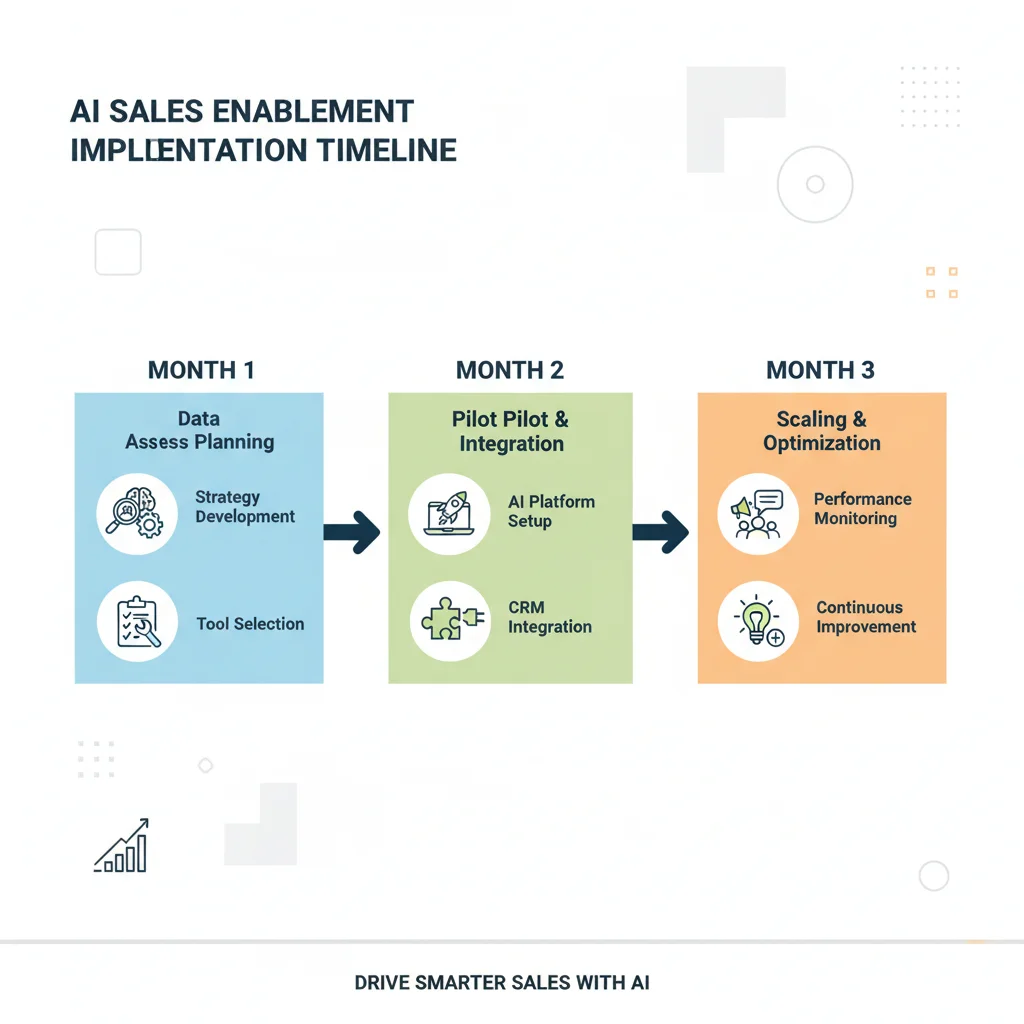
Month 1: Foundation and Planning for AI Sales Enablement
The first month is critical for laying a solid foundation. This involves a thorough assessment of your current sales operations, identifying pain points, defining clear objectives, and selecting the right AI tools. Without a robust plan, even the most advanced AI solutions can fall short.
Phase 1: Current State Assessment and Goal Definition (Weeks 1-2)
1. Audit Existing Sales Processes and Data
- Identify Bottlenecks: Where do your sales reps spend most of their non-selling time? What stages of the sales cycle have the lowest conversion rates? Understanding these areas is key to pinpointing where AI can have the most impact.
- Data Quality Assessment: AI thrives on data. Evaluate the quality, completeness, and accessibility of your current sales data (CRM, marketing automation, customer interactions). Poor data will lead to poor AI insights. This might involve cleaning up your CRM, integrating disparate data sources, or establishing new data collection protocols.
- Technology Stack Review: What sales enablement tools are you currently using? How well do they integrate? Can they be augmented or replaced by AI solutions?
2. Define Specific, Measurable, Achievable, Relevant, Time-bound (SMART) Goals
- Conversion Lift Target: Our primary goal is a 10% conversion lift. Break this down: is it a 10% increase in lead-to-opportunity, opportunity-to-close, or overall sales conversion?
- Secondary Metrics: Consider other metrics like reduced sales cycle length, increased average deal size, improved sales rep productivity, or enhanced customer satisfaction.
- Key Performance Indicators (KPIs): Establish baseline KPIs to track progress. These might include lead response time, personalized content usage, win rates, and time spent on administrative tasks.
3. Identify Key Use Cases for AI in Sales
Based on your audit and goals, pinpoint specific areas where AI can deliver immediate value. Common use cases for AI sales enablement include:
- Lead Scoring and Prioritization: AI can analyze vast amounts of data to identify high-potential leads, allowing sales reps to focus their efforts.
- Content Recommendations: AI algorithms can suggest the most relevant content (case studies, whitepapers, demos) at each stage of the buyer’s journey.
- Sales Forecasting: More accurate predictions of future sales performance.
- Conversational AI (Chatbots): Automating initial customer interactions, qualifying leads, and answering frequently asked questions.
- Sales Coaching and Training: AI can analyze sales calls and provide real-time feedback or identify coaching opportunities.
- Automated Administrative Tasks: AI can handle data entry, scheduling, and report generation, freeing up sales reps’ time.
Phase 2: Vendor Selection and Team Alignment (Weeks 3-4)
1. Research and Select AI Sales Enablement Tools
The market is flooded with AI solutions. Focus on tools that align with your identified use cases and seamlessly integrate with your existing CRM (e.g., Salesforce, HubSpot). Look for vendors with a strong track record, robust support, and scalability. Consider solutions for:
- CRM Augmentation: AI-powered features within or integrated with your CRM.
- Sales Engagement Platforms: Tools that automate outreach and track engagement, often with AI insights.
- Conversational Intelligence: Platforms that analyze sales calls and meetings.
- Predictive Analytics: Standalone or integrated solutions for forecasting and lead prioritization.
2. Budget Allocation and Resource Planning
Determine the financial investment required for AI tools, training, and potential external consulting. Allocate internal resources, identifying a dedicated project manager and a core team responsible for implementation and adoption.
3. Stakeholder Buy-in and Team Training Strategy
Secure buy-in from leadership by demonstrating the potential ROI. Crucially, involve your sales team early. Address their concerns, highlight the benefits (e.g., less admin, more selling time, higher commissions), and begin planning for comprehensive training. Acknowledge that change can be daunting and emphasize the supportive nature of AI, not as a replacement for human interaction, but as an enhancer.
Month 2: Pilot and Integration of AI Sales Enablement
With a plan in place, Month 2 focuses on piloting your chosen AI solutions, integrating them into your existing workflows, and beginning the crucial process of training your sales team. This phase is about testing, learning, and refining.
Phase 3: Initial Implementation and Integration (Weeks 5-6)
1. Phased Rollout with a Pilot Group
Avoid a full-scale launch immediately. Select a small, enthusiastic pilot group of sales reps who are open to new technologies. This allows you to test the AI tools in a controlled environment, gather feedback, and iron out any kinks before broader deployment. A pilot group provides valuable insights into user experience and practical application.
2. Data Integration and Synchronization
Ensure seamless integration between your new AI tools and your existing CRM, marketing automation platforms, and other sales enablement systems. Data must flow freely and accurately to maximize AI’s effectiveness. This might require API integrations or custom connectors. Data integrity is paramount; garbage in, garbage out applies strongly to AI.
3. Initial Configuration and Customization
Configure the AI tools to your specific business needs. This could involve setting up lead scoring rules, customizing content recommendation parameters, or training conversational AI models with your product knowledge and sales scripts. The more tailored the AI, the more effective it will be.
Phase 4: Training and Early Adoption (Weeks 7-8)
1. Comprehensive Sales Team Training
Conduct thorough training sessions for your pilot group, focusing on how to effectively use the new AI tools. Emphasize practical scenarios and hands-on exercises. Training should cover:
- Tool Functionality: How to navigate and utilize each feature.
- Best Practices: How to leverage AI insights for better conversations and decisions.
- Workflow Integration: How the AI tools fit into their daily sales routine.
- Troubleshooting: Basic problem-solving and who to contact for support.
Provide ongoing support and resources, such as user manuals, FAQs, and a dedicated support channel.
2. Monitor Performance and Gather Feedback
Closely monitor the pilot group’s performance against the defined KPIs. Collect qualitative feedback through surveys, one-on-one interviews, and regular check-ins. What’s working well? What are the challenges? What features are missing? This feedback is invaluable for iterative improvements.
3. Refine and Adjust
Based on the feedback and performance data, make necessary adjustments to the AI tool configurations, integration points, and training materials. This iterative process is crucial for optimizing the system before a wider rollout. Flexibility and a willingness to adapt are key during this phase.
Month 3: Scaling and Optimization for Sustained Conversion Lift
The final month focuses on expanding the AI sales enablement initiative across your entire sales organization, continuously optimizing its performance, and establishing a culture of data-driven selling. This is where you solidify your path to a 10% conversion lift and beyond.
Phase 5: Full Rollout and Advanced Training (Weeks 9-10)
1. Company-Wide Deployment
Once the pilot is successful and refinements are made, roll out the AI sales enablement tools to the entire sales team. Ensure that all sales reps have access, proper accounts, and are onboarded effectively. Communicate the successes of the pilot program to build enthusiasm and encourage adoption.
2. Advanced Training and Ongoing Support
Provide more advanced training sessions for the broader team, addressing specific roles and advanced functionalities. Establish a continuous learning environment with regular workshops, webinars, and knowledge-sharing sessions. Create a dedicated internal champion or team to provide ongoing support and answer questions.
3. Integrate AI into Sales Playbooks and Workflows
Update your sales playbooks and standard operating procedures to reflect the new AI-driven processes. Ensure that AI insights are naturally integrated into every stage of the sales cycle, from prospecting and discovery to demo delivery and closing. For example, instruct reps to check AI-generated lead scores before making calls or to use AI-recommended content in their follow-up emails.
Phase 6: Performance Analysis and Continuous Optimization (Weeks 11-12)
1. Comprehensive Performance Review
At the end of the 3-month period, conduct a thorough analysis of your sales performance against the initial baseline and SMART goals. Quantify the conversion lift achieved. Look at other KPIs such as sales cycle length, average deal size, rep productivity, and customer engagement metrics. Use A/B testing where possible to isolate the impact of AI.
2. Data-Driven Optimization
Leverage the data generated by the AI tools themselves to identify further areas for optimization. Are certain AI recommendations performing better than others? Are there specific types of leads where AI scoring is particularly effective? Use these insights to fine-tune algorithms, content recommendations, and sales strategies. This is an ongoing process; AI models improve with more data and feedback.
3. Feedback Loop and Iteration
Establish a continuous feedback loop with your sales team. Regularly solicit their input on how AI tools are working, what improvements they suggest, and what new challenges they face. This collaboration is vital for long-term success. Encourage a culture where sales reps see AI as a valuable assistant rather than a threat or an extra burden.
4. Explore New AI Capabilities
The AI landscape evolves rapidly. Continuously research new AI functionalities and tools that could further enhance your AI sales enablement efforts. Consider expanding into areas like AI-powered proposal generation, sentiment analysis of customer interactions, or advanced predictive analytics for churn prevention.

Key Considerations for Successful AI Sales Enablement
Beyond the roadmap, several factors are crucial for the sustained success of your AI sales enablement initiative:
Data Privacy and Compliance
Given the increasing focus on data privacy (e.g., CCPA, state-specific regulations in the U.S.), ensure your AI tools and data handling practices are fully compliant. Transparency with customers about data usage is also important for building trust.
Change Management
Implementing AI is a significant organizational change. Proactive change management strategies are essential to overcome resistance, foster adoption, and ensure a smooth transition. Communicate benefits clearly, provide ample support, and celebrate early wins.
Human-AI Collaboration
Emphasize that AI is designed to augment, not replace, human sales professionals. The most effective AI sales enablement strategies foster a symbiotic relationship where AI handles repetitive tasks and provides insights, allowing human reps to focus on relationship building, complex problem-solving, and strategic selling.
Scalability and Future-Proofing
Choose AI solutions that can scale with your business growth. Consider vendor roadmaps and ensure the technology can adapt to future market demands and technological advancements. A flexible architecture will save you headaches down the line.
Measuring ROI Beyond Conversion Lift
While a 10% conversion lift is a fantastic goal, remember to measure other returns on investment. This includes increased sales productivity, reduced operational costs, improved customer satisfaction, and better sales forecasting accuracy. A holistic view of ROI will justify continued investment.
Conclusion: Embracing the Future of Sales with AI
Implementing AI sales enablement is a transformative journey that can redefine your sales effectiveness and deliver substantial business growth. This 3-month roadmap provides a structured, actionable framework for U.S. businesses to achieve a 10% conversion lift by strategically integrating AI into their sales processes.
The future of sales is intelligent, personalized, and data-driven. By embracing AI, you’re not just adopting new technology; you’re investing in a more efficient, effective, and competitive sales organization. Start your AI sales enablement journey today, empower your sales team, and watch your conversion rates soar.
The path to a 10% conversion lift is clear. With careful planning, strategic implementation, and continuous optimization, your U.S. business can harness the power of AI to unlock unprecedented sales success. Don’t just keep up with the competition; lead the charge with intelligent sales enablement.