Sales Enablement CRM Integration: 2026 Blueprint for Seamless Workflows

In the rapidly evolving landscape of sales and technology, the synergy between Customer Relationship Management (CRM) systems and Sales Enablement platforms has become not just beneficial, but absolutely critical. As we look towards 2026, the imperative for seamless workflows and optimized sales processes is more pronounced than ever. This article delves into a comprehensive blueprint for achieving unparalleled efficiency and effectiveness through robust CRM Sales Enablement integration, offering practical solutions that will define the future of sales.
The modern sales environment is characterized by informed buyers, intense competition, and a constant demand for personalized experiences. Sales teams are under immense pressure to perform, requiring access to the right information, at the right time, and in the right context. This is precisely where the power of integrated CRM Sales Enablement shines. By harmonizing these two vital functions, organizations can empower their sales force, streamline operations, and ultimately drive significant revenue growth.
The Evolution of Sales: Why Integration is Non-Negotiable by 2026
Gone are the days when CRM was merely a contact database and sales enablement was a separate repository of content. Today, and increasingly by 2026, these systems must operate as a unified ecosystem. The sales journey is no longer linear; it’s dynamic and requires agile responses. Without deep integration, sales teams face a multitude of challenges:
- Fragmented Data: Information silos lead to incomplete customer profiles, missed opportunities, and inconsistent messaging.
- Inefficient Workflows: Manual data entry, switching between applications, and searching for relevant content waste valuable selling time.
- Lack of Personalization: Generic outreach fails to resonate with today’s sophisticated buyers, who expect tailored interactions.
- Limited Performance Insights: Without a holistic view, it’s difficult to identify what’s working, what’s not, and where to optimize.
- Slow Onboarding: New sales reps struggle to get up to speed without a cohesive system that guides them through processes and resources.
The 2026 sales landscape demands a proactive approach. Organizations that prioritize CRM Sales Enablement integration will be better positioned to adapt to market shifts, leverage advanced analytics, and deliver superior customer experiences. This isn’t just about technological adoption; it’s about a strategic realignment of how sales operates.
Understanding the Core Components: CRM and Sales Enablement
What is CRM?
CRM, or Customer Relationship Management, is a technology for managing all your company’s relationships and interactions with customers and potential customers. The goal is simple: improve business relationships to grow your business. A CRM system helps companies stay connected to customers, streamline processes, and improve profitability. It typically stores customer contact information, purchase history, interactions, and other relevant data, providing a 360-degree view of the customer.
What is Sales Enablement?
Sales Enablement is the iterative process of providing your sales team with the resources they need to close more deals. These resources can include content (playbooks, presentations, case studies), tools (AI assistants, communication platforms), training, and coaching. The primary objective of sales enablement is to ensure that sales reps have the knowledge, skills, and assets necessary to engage prospects effectively throughout the sales cycle.
The Symbiotic Relationship: Why They Need Each Other
CRM provides the ‘who’ and the ‘what’ – who the customer is, what their history is, what their needs are. Sales enablement provides the ‘how’ and the ‘when’ – how to engage them, what content to use, and when to deliver it. Without CRM, sales enablement lacks the contextual data to personalize its resources. Without sales enablement, CRM data might not be fully leveraged to drive actual sales interactions. The integration of CRM Sales Enablement creates a powerful feedback loop, where insights from customer interactions (CRM) inform and refine enablement strategies, and effective enablement activities enrich CRM data.
The 2026 Blueprint: Key Pillars of Integrated CRM Sales Enablement
Building a robust CRM Sales Enablement architecture for 2026 requires a strategic approach focused on several key pillars:
1. Unified Data Architecture and Single Source of Truth
The foundation of any successful integration is a unified data architecture. All customer data, sales activities, content engagement metrics, and training progress should reside in or be accessible through a single, synchronized platform. This eliminates data duplication, ensures data integrity, and provides a comprehensive view of the customer and sales performance.
- Practical Solution: Implement a robust API-driven integration between your CRM and sales enablement platform. Utilize data connectors and middleware solutions to ensure real-time synchronization. Establish a clear data governance strategy to define data ownership, quality standards, and access controls.
- 2026 Vision: AI-powered data harmonization tools will automatically identify and resolve data discrepancies, enriching customer profiles with predictive insights derived from both CRM and enablement data.
2. Contextual Content Delivery and Management
Sales reps waste an inordinate amount of time searching for the right content. An integrated system should push relevant content to them based on the specific stage of the sales cycle, prospect’s industry, role, and past interactions recorded in the CRM.
- Practical Solution: Tag and categorize all sales content within your enablement platform with metadata that aligns with CRM fields (e.g., industry, company size, product interest, sales stage). Configure your enablement platform to automatically suggest or display relevant content within the CRM interface when a sales rep is working on an opportunity or contact.
- 2026 Vision: AI-driven content recommendation engines will analyze CRM data, prospect behavior, and successful sales patterns to dynamically generate or adapt content in real-time, personalized for each interaction.

3. Automated Workflows and Task Management
Manual administrative tasks detract from selling time. Integration enables the automation of routine tasks, freeing up sales reps to focus on what they do best: selling.
- Practical Solution: Set up automated triggers in your integrated system. For example, when an opportunity moves to a new stage in CRM, automatically assign relevant training modules, content, or follow-up tasks in the enablement platform. Automate lead assignment based on CRM criteria directly into the sales rep’s enablement dashboard.
- 2026 Vision: Hyper-automation will leverage RPA (Robotic Process Automation) and AI to handle complex, multi-step workflows, from scheduling meetings based on prospect availability and CRM data to drafting personalized email sequences.
4. Personalized Training and Coaching
Effective training and coaching are essential for sales performance. Integrating CRM data provides invaluable context for personalized development plans.
- Practical Solution: Use CRM performance data (e.g., win rates by product, average deal size, call activity) to identify skill gaps. Link these insights to specific training modules or coaching sessions within the enablement platform. Track completion rates and comprehension scores in the enablement platform and surface them in the CRM for managers.
- 2026 Vision: AI-powered coaching tools will analyze sales call recordings (integrated from communication platforms into CRM), identify areas for improvement, and suggest specific training content or coaching prompts from the enablement platform, all within the CRM interface.
5. Advanced Analytics and Reporting
Measuring the effectiveness of both sales activities and enablement initiatives is crucial. Integrated analytics provide a holistic view of the sales pipeline and content performance.
- Practical Solution: Create unified dashboards that pull data from both CRM (e.g., pipeline velocity, conversion rates) and sales enablement (e.g., content usage, engagement rates, training completion). Correlate content usage with deal progression and win rates to identify high-performing assets.
- 2026 Vision: Predictive analytics will leverage integrated data to forecast sales outcomes, identify at-risk deals, and recommend proactive enablement interventions. AI will provide granular insights into individual sales rep performance, content effectiveness, and customer engagement patterns.
Practical Steps to Implement Your 2026 CRM Sales Enablement Blueprint
Step 1: Define Your Strategy and Objectives
Before diving into technology, clearly articulate your sales goals for 2026. What specific challenges are you trying to solve? What does success look like? Involve sales leaders, marketing, and IT in this process. A well-defined strategy for CRM Sales Enablement will guide your technology choices and implementation plan.
Step 2: Audit Your Current Systems and Processes
Inventory your existing CRM, sales enablement, and related sales tech stack. Identify data silos, manual processes, and areas of inefficiency. Understand how your sales team currently operates and where they face friction. This audit will highlight critical integration points and potential roadblocks.
Step 3: Select the Right Platforms (or Optimize Existing Ones)
Choose CRM and sales enablement platforms that offer robust API capabilities, a track record of successful integrations, and scalability. Prioritize user-friendliness for your sales team. If you have existing systems, explore their integration capabilities and consider third-party connectors or middleware if native options are limited. Focus on platforms that support modern CRM Sales Enablement best practices.
Step 4: Design the Integration Architecture
Work with your IT team or integration specialists to design how data will flow between your CRM and sales enablement platforms. This includes defining data fields to be synchronized, trigger points for automation, and rules for data transformation. Consider a phased approach, starting with critical integrations and expanding over time.
Step 5: Implement and Test Thoroughly
Execute the integration plan. This will involve configuration, custom development (if needed), and extensive testing. Test all workflows, data synchronization, and user experiences to ensure everything works as expected. Involve a diverse group of sales reps in user acceptance testing.
Step 6: Train Your Sales Team
A powerful integrated system is useless if your sales team doesn’t know how to use it. Provide comprehensive training that highlights the benefits of the new integrated workflow, focusing on how it makes their jobs easier and more effective. Ongoing training and accessible support are crucial for sustained adoption of CRM Sales Enablement tools.
Step 7: Monitor, Analyze, and Optimize
Integration is not a one-time project. Continuously monitor performance metrics, gather feedback from your sales team, and analyze the impact on key sales KPIs. Use these insights to identify areas for improvement and further optimization. The 2026 blueprint emphasizes continuous iteration and refinement.
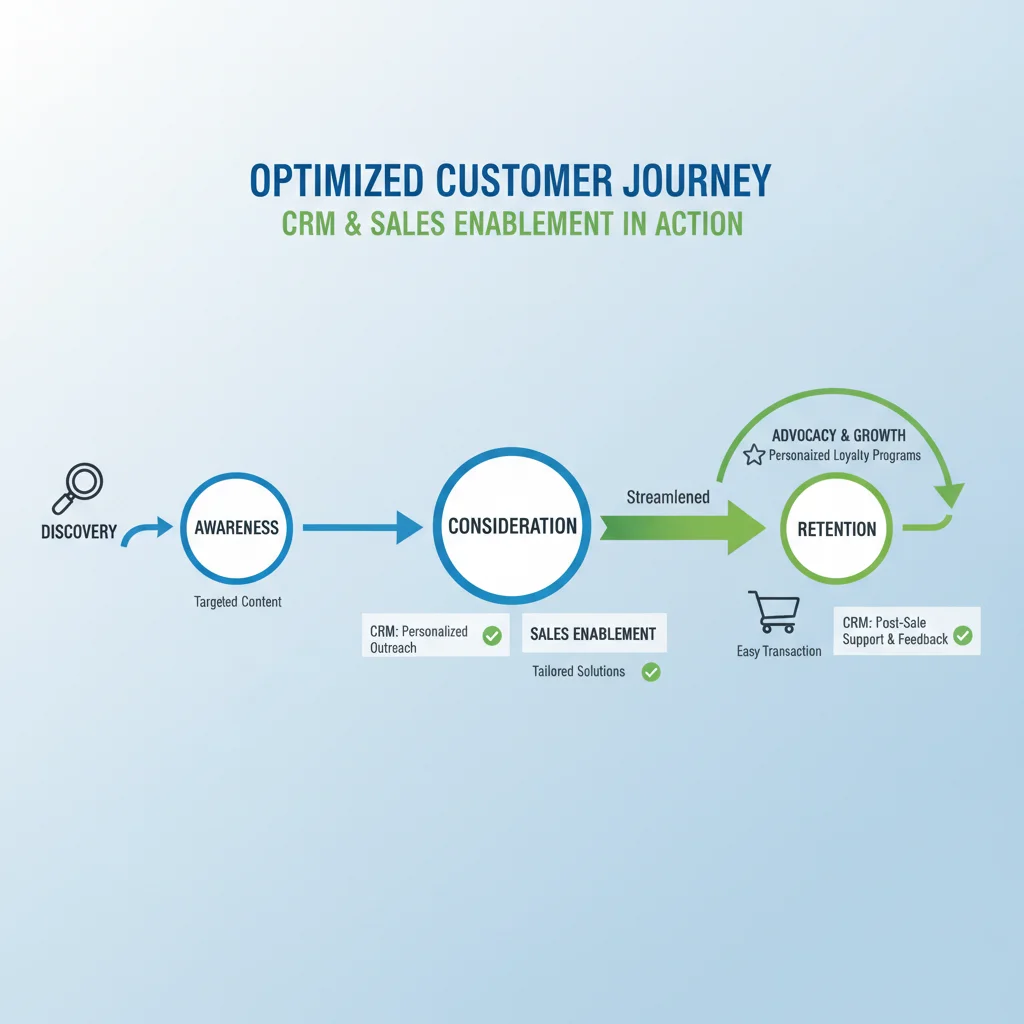
Benefits of a Fully Integrated CRM Sales Enablement Ecosystem by 2026
The rewards of strategic CRM Sales Enablement integration are multifaceted and profound:
- Increased Sales Productivity: By automating tasks, providing instant access to content, and streamlining workflows, sales reps spend more time selling and less time on administrative overhead.
- Enhanced Customer Experience: Personalized interactions, consistent messaging, and a holistic understanding of customer needs lead to stronger relationships and higher customer satisfaction.
- Faster Sales Cycle: Equipping reps with the right tools and information at each stage accelerates deal progression and reduces time-to-close.
- Improved Win Rates: Better prepared reps, armed with relevant content and insights, are more effective in their engagements, leading to higher conversion rates.
- More Accurate Forecasting: Unified data and advanced analytics provide a clearer, more reliable picture of the sales pipeline and future revenue.
- Better Sales Rep Onboarding and Retention: A structured and supportive environment accelerates ramp-up time for new hires and increases job satisfaction for experienced reps.
- Optimized Marketing ROI: Marketers gain insights into which content assets are most effective, allowing them to refine their strategies and produce more impactful materials.
- Competitive Advantage: Organizations with seamless CRM Sales Enablement integration will outpace competitors relying on fragmented systems.
Challenges and Considerations for the Future
While the benefits are clear, implementing a 2026-ready CRM Sales Enablement blueprint comes with its own set of challenges:
- Data Security and Privacy: As more data is integrated, ensuring robust security measures and compliance with privacy regulations (e.g., GDPR, CCPA) becomes paramount.
- Change Management: Overcoming resistance to new tools and processes requires strong leadership, clear communication, and continuous support.
- Vendor Lock-in: Be mindful of choosing platforms that offer flexibility and open APIs to avoid being locked into a single vendor’s ecosystem.
- Scalability: Ensure your integrated architecture can scale with your business growth and evolving technological needs.
- Maintaining Data Quality: Continuous efforts are needed to ensure the accuracy and completeness of data across all integrated systems.
- Emerging Technologies: Staying abreast of new AI capabilities, automation tools, and data analytics techniques will be crucial for sustained competitive advantage.
Addressing these challenges proactively will ensure a smoother transition and maximize the return on your CRM Sales Enablement investment.
The Human Element: Empowering the Sales Professional of 2026
Amidst all the technological advancements, it’s crucial to remember that CRM Sales Enablement tools are designed to augment, not replace, the human sales professional. The sales rep of 2026 will be a highly skilled strategist and relationship builder, empowered by intelligent systems. They will leverage integrated data to:
- Understand Buyer Intent: Proactively identify prospects ready to buy based on behavioral data and predictive analytics.
- Craft Hyper-Personalized Experiences: Deliver tailored messages, content, and solutions that resonate deeply with individual prospects.
- Act as Trusted Advisors: Focus on consultative selling, providing value beyond product features, thanks to a comprehensive understanding of customer needs and industry trends.
- Optimize Their Own Performance: Utilize AI-driven insights to refine their sales techniques, prioritize tasks, and manage their pipeline more effectively.
The goal is to free up sales professionals from mundane tasks, allowing them to dedicate more time to high-value activities that require human empathy, creativity, and strategic thinking.
Conclusion: Your Path to Sales Excellence in 2026
The journey towards a fully optimized CRM Sales Enablement ecosystem is an ongoing one, but the rewards for organizations that commit to this blueprint are substantial. By 2026, seamless integration will be the hallmark of high-performing sales teams, driving not just efficiency but a fundamental transformation in how businesses engage with their customers and achieve growth.
Embrace the future by dismantling data silos, automating workflows, and empowering your sales force with contextual intelligence. The time to build your 2026 blueprint for integrated CRM Sales Enablement is now. It’s an investment in productivity, customer satisfaction, and sustainable revenue growth that will define your success in the years to come.