Boost Q1 2026 Sales: 7 Sales Enablement Automation Tools You Need Now

The competitive landscape of sales is constantly evolving, demanding more than just skilled salespeople. To truly thrive and achieve ambitious targets, especially as we look towards Q1 2026, organizations must embrace the power of Sales Enablement Automation. This isn’t just about making tasks easier; it’s about fundamentally transforming how your sales team operates, empowering them with the right content, training, and insights at every stage of the buyer’s journey. By automating repetitive tasks, providing instant access to crucial information, and personalizing interactions, businesses can significantly boost productivity, enhance the customer experience, and ultimately, drive remarkable revenue growth.
As the new year approaches, the pressure to hit aggressive Q1 targets intensifies. This article delves into the critical role of Sales Enablement Automation and highlights seven indispensable tools that can revolutionize your sales strategy. From intelligent content management to advanced CRM integrations and AI-powered analytics, these practical solutions are designed to equip your team with everything they need to succeed in a fast-paced market. Prepare to discover how these technologies can streamline your operations, reduce friction, and unleash your sales team’s full potential.
The Imperative of Sales Enablement Automation for Q1 2026 Success
In today’s digital-first sales environment, the traditional approach of simply arming sales reps with product knowledge and a quota is no longer sufficient. Buyers are more informed, more demanding, and expect personalized experiences. This shift necessitates a more strategic, data-driven approach to sales, making Sales Enablement Automation not just a luxury, but a core component of any successful sales strategy for Q1 2026 and beyond.
Sales enablement, at its core, is about providing sales teams with the resources, tools, and training they need to sell more effectively. When you introduce automation into this equation, you amplify its impact exponentially. Automated sales enablement ensures that your sales reps have access to the most relevant content, updated product information, and personalized messaging precisely when they need it. It reduces the time spent on administrative tasks, allowing them to focus on what they do best: selling.
For Q1 2026, the stakes are particularly high. The start of a new fiscal year often sets the tone for the entire year’s performance. Investing in robust Sales Enablement Automation tools now can provide a significant competitive advantage, enabling your team to hit the ground running, accelerate sales cycles, and secure a strong foothold in the market. It’s about creating a repeatable, scalable, and highly efficient sales process that consistently delivers results.
Consider the myriad benefits: improved sales rep onboarding and training, consistent messaging across all channels, enhanced lead qualification, faster proposal generation, and deeper insights into buyer behavior. Each of these elements contributes to a more productive, motivated, and ultimately, more successful sales force. Without automation, many of these benefits remain elusive, leaving sales teams to grapple with manual processes, outdated information, and missed opportunities.
Therefore, understanding and implementing the right Sales Enablement Automation tools is paramount. The following sections will introduce you to seven such tools, each offering unique capabilities to address different facets of your sales enablement strategy, all geared towards making your Q1 2026 sales goals not just achievable, but surpassable.
1. Advanced CRM with Integrated Sales Enablement Features
At the heart of any effective sales operation is a robust Customer Relationship Management (CRM) system. However, for true Sales Enablement Automation, a basic CRM is no longer enough. Modern CRMs, like Salesforce Sales Cloud, HubSpot Sales Hub, or Microsoft Dynamics 365 Sales, now come with deeply integrated sales enablement features that transform them into powerful productivity engines.
These advanced CRMs go beyond tracking customer interactions. They offer functionalities such as automated lead scoring, personalized email sequencing, deal stage management with automated triggers, and even AI-driven recommendations for next best actions. Imagine a system that not only tells your sales rep who to call but also suggests the most effective script or content piece to use based on the prospect’s history and current stage in the sales funnel. This is the power of integrated Sales Enablement Automation within your CRM.
For Q1 2026, leveraging a CRM with these capabilities means your sales team spends less time on manual data entry and more time engaging with prospects. It ensures consistency in messaging, allows for targeted outreach, and provides a centralized hub for all customer-related information. Furthermore, these platforms often include analytics dashboards that offer real-time insights into sales performance, pipeline health, and individual rep effectiveness, enabling managers to make data-driven decisions and provide timely coaching.
When selecting a CRM for enhanced Sales Enablement Automation, consider its ability to integrate with other tools in your tech stack, its scalability to grow with your business, and its user-friendliness for your sales team. A powerful CRM that isn’t adopted by your reps is merely an expensive database. The goal is to create a seamless, intuitive experience that empowers them to sell more efficiently.
2. AI-Powered Sales Content Management Systems (CMS)
Content is king in sales, but only if it’s the right content, delivered at the right time. Traditional content management can be a chaotic process, with sales reps struggling to find the latest versions of brochures, case studies, or presentations. This is where AI-powered Sales Content Management Systems (CMS) become indispensable for effective Sales Enablement Automation.
Tools like Highspot, Seismic, or Showpad are designed to centralize all sales collateral. But their true power lies in their AI capabilities. These systems can analyze which content pieces are most effective at different stages of the sales cycle, for different buyer personas, or even for specific industries. They can then recommend the most relevant content to a sales rep in real-time, based on the context of their current interaction with a prospect.
Imagine a scenario where a sales rep is preparing for a meeting. Instead of sifting through folders, the AI-powered CMS instantly suggests the top three case studies, a personalized pitch deck, and a relevant whitepaper, all proven to resonate with similar prospects. This not only saves valuable time but also significantly increases the chances of a successful engagement.
For Q1 2026, implementing an AI-powered Sales CMS means your sales team will always be equipped with the most impactful content. It ensures brand consistency, facilitates easy content updates, and provides invaluable analytics on content usage and effectiveness. This data allows marketing and sales teams to collaborate more closely, optimizing content creation and ultimately driving better sales outcomes through intelligent Sales Enablement Automation.
3. Sales Engagement Platforms (SEPs)
Sales Engagement Platforms (SEPs) are a cornerstone of modern Sales Enablement Automation, acting as a central hub for all outbound sales activities. Tools such as Salesloft, Outreach, or Groove automate and optimize communication sequences, ensuring consistent and personalized outreach at scale.
SEPs allow sales teams to create multi-channel sequences that combine emails, calls, social media touches, and even direct mail, all orchestrated to nurture prospects through the sales funnel. The automation aspect means that tasks like sending follow-up emails, scheduling calls, or prompting social media interactions are handled automatically or with minimal manual input, freeing up reps to focus on high-value conversations.
Key features often include A/B testing for email templates, call logging, meeting scheduling automation, and detailed analytics on engagement rates. This data is crucial for understanding what messages resonate with prospects and for continuously optimizing outreach strategies. For Q1 2026, leveraging an SEP can drastically increase the volume and effectiveness of your sales team’s outreach, ensuring no lead falls through the cracks and every interaction is purposeful.
By streamlining communication and providing actionable insights, SEPs empower sales reps to maintain consistent engagement with a larger number of prospects, personalize their interactions based on real-time data, and ultimately accelerate the sales cycle. This level of communication automation is vital for any organization aiming for significant growth through enhanced Sales Enablement Automation.
4. Conversational AI and Chatbots for Lead Qualification
The initial stages of the sales process, particularly lead qualification, can be time-consuming and resource-intensive. Conversational AI and chatbots offer a powerful solution for automating this crucial step, significantly enhancing Sales Enablement Automation and freeing up human sales reps for more complex interactions.
Tools like Drift, Intercom, or LiveChat with AI capabilities can engage website visitors 24/7, answer common questions, gather essential information, and even qualify leads based on predefined criteria. Imagine a prospect visiting your website outside of business hours; a chatbot can still collect their contact details, understand their needs, and schedule a meeting with a sales rep for the next day, ensuring no opportunity is lost.
For Q1 2026, integrating conversational AI into your sales process means faster lead response times, improved lead quality, and a more efficient allocation of your sales team’s efforts. These chatbots can be programmed to handle a wide range of inquiries, providing instant gratification to prospects and collecting valuable data that enriches your CRM. They can also seamlessly hand off qualified leads to the appropriate sales rep, complete with a summary of the conversation.
This level of automation not only improves the prospect experience by providing immediate assistance but also allows your sales team to focus on leads that are genuinely interested and ready to engage, thereby boosting overall sales productivity and contributing significantly to your Sales Enablement Automation strategy.
5. Proposal and Contract Management Software
Generating proposals and managing contracts can be a laborious and error-prone process, often slowing down the final stages of the sales cycle. Proposal and contract management software provides essential Sales Enablement Automation by streamlining these critical administrative tasks.
Tools such as PandaDoc, DocuSign Gen, or Conga Composer automate the creation, delivery, tracking, and e-signing of proposals, quotes, and contracts. These platforms often integrate with CRMs, pulling in relevant customer data to auto-populate documents, reducing manual input and minimizing errors. Templates ensure brand consistency and compliance, while version control keeps track of all changes.
Imagine a sales rep needing to send a personalized proposal. Instead of manually copying and pasting information, the system automatically generates a professional, branded proposal with the correct pricing and terms, ready for review and electronic signature within minutes. This speed and accuracy are invaluable in a competitive market.
For Q1 2026, implementing such a system means faster deal closures, improved accuracy in documentation, and a significant reduction in administrative overhead for your sales team. It provides visibility into the status of every proposal and contract, allowing reps to follow up proactively and identify bottlenecks. This automation of the final sales stages is a powerful contributor to overall sales efficiency and a key component of effective Sales Enablement Automation.
6. Sales Coaching and Training Platforms
Even the most advanced tools are only as effective as the people using them. Continuous sales coaching and training are vital for maximizing the potential of your sales team. Modern sales coaching and training platforms leverage automation and AI to provide personalized and scalable development opportunities, making them crucial for Sales Enablement Automation.
Platforms like Gong.io, Chorus.ai, or Mindtickle use AI to analyze sales conversations (calls, emails, meetings) to identify winning behaviors, areas for improvement, and coaching opportunities. They can transcribe calls, highlight key moments, and provide data-driven feedback to reps and managers. This moves beyond subjective coaching to objective, data-backed insights.
Imagine a new sales rep. Instead of waiting for a manager to review a few calls, the AI platform can analyze hundreds of their interactions, identify patterns in their questioning, objection handling, or closing techniques, and then suggest specific training modules or coaching points. This personalized approach accelerates onboarding and continuous skill development.
For Q1 2026, investing in these platforms ensures your sales team is constantly learning and adapting. They provide a scalable way to deliver training, onboard new hires efficiently, and ensure consistent messaging and best practices across the entire team. By automating the analysis and delivery of coaching insights, these tools significantly enhance the ‘enablement’ aspect of Sales Enablement Automation, leading to a more skilled and confident sales force.

7. Predictive Analytics and Sales Forecasting Tools
Accurate sales forecasting is critical for strategic planning, resource allocation, and setting realistic Q1 2026 goals. Predictive analytics and sales forecasting tools leverage data science and machine learning to provide more accurate and reliable forecasts, making them an indispensable element of advanced Sales Enablement Automation.
While many CRMs offer basic forecasting, specialized tools like Clari, Aviso, or Anaplan go much deeper. They analyze historical sales data, pipeline health, external market trends, and individual rep performance to generate highly accurate predictions. These tools can identify deals at risk, highlight opportunities for acceleration, and even predict the likelihood of a deal closing.
Imagine a sales manager needing to report on Q1 projections. Instead of relying on gut feelings or manual calculations, the predictive analytics tool provides a data-backed forecast, complete with confidence levels and insights into the factors influencing the predictions. This allows for proactive adjustments to strategy, resource deployment, and even individual sales coaching.
For Q1 2026, leveraging predictive analytics means moving from reactive to proactive sales management. It enables leadership to identify potential roadblocks before they impact performance, optimize resource allocation, and confidently set and pursue ambitious targets. By automating the complex process of data analysis and forecasting, these tools provide the strategic intelligence needed to drive superior sales outcomes through sophisticated Sales Enablement Automation.
Integrating for Maximum Impact: The Synergy of Sales Enablement Automation
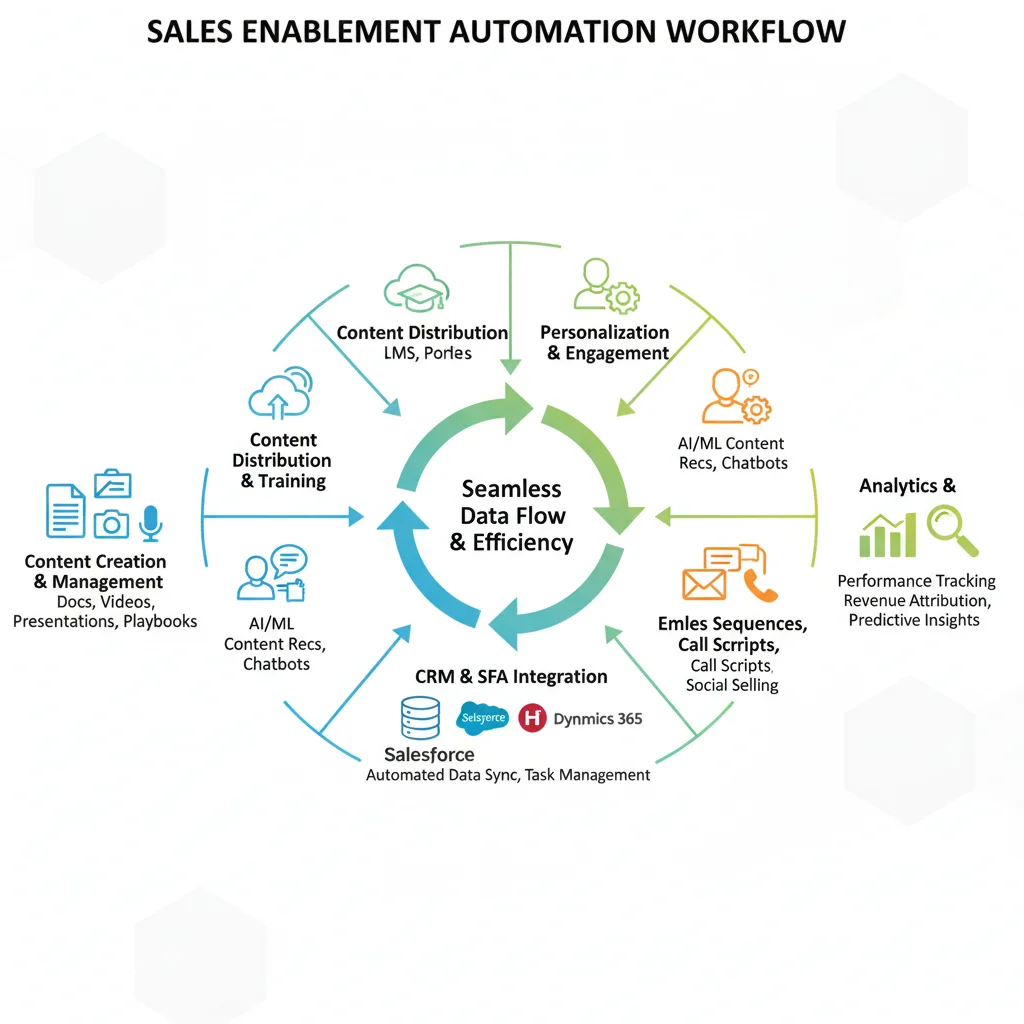
While each of these seven tools offers significant benefits individually, the true power of Sales Enablement Automation emerges when they are integrated into a cohesive ecosystem. Think of it as a well-oiled machine where each component plays a vital role, feeding data and insights into the next, creating a seamless and highly efficient sales process.
For instance, an advanced CRM acts as the central nervous system, housing customer data. A Sales Engagement Platform (SEP) pulls this data to personalize outreach. An AI-powered Sales CMS then recommends the most effective content for those outreach efforts. Conversational AI qualifies leads and pushes them into the CRM, ready for the SEP. When a deal progresses, proposal management software automates document creation, and finally, predictive analytics tools provide insights into the likelihood of closure and future forecasting, drawing on data from all these systems.
This interconnectedness reduces manual effort, eliminates data silos, and ensures that every member of the sales team has access to the most accurate and up-to-date information. It also provides a holistic view of the sales pipeline, allowing for better decision-making and more effective coaching. For Q1 2026, the competitive advantage will undoubtedly belong to organizations that master this integration, transforming disparate tools into a unified, powerful Sales Enablement Automation platform.
The journey to full integration might seem daunting, but it doesn’t have to be completed overnight. Start with identifying your most pressing pain points and gradually introduce tools that address those needs, always keeping an eye on how they can connect with your existing tech stack. Prioritize tools that offer robust APIs and strong integration capabilities.
The Future of Sales: Beyond Q1 2026 with Continuous Automation
The landscape of sales will continue to evolve, with AI and automation playing an even more central role. What begins as a strategic investment for Q1 2026 will become the standard operating procedure for successful sales organizations for years to come. The goal of Sales Enablement Automation is not just to improve current performance but to build a resilient, adaptable, and highly efficient sales engine for the long term.
Looking beyond Q1 2026, expect further advancements in personalized AI coaching, hyper-intelligent content recommendations, and even more sophisticated predictive models that can anticipate market shifts and buyer behaviors. The sales professional of the future will be less concerned with administrative tasks and more focused on strategic thinking, building relationships, and leveraging intelligent tools to close complex deals.
Embracing Sales Enablement Automation today is an investment in that future. It’s about empowering your sales team to be more effective, more efficient, and ultimately, more successful. It’s about creating a sales culture that thrives on data, innovation, and continuous improvement. As you plan your strategies for the upcoming year, remember that the right automation tools are not just a convenience; they are a necessity for achieving and sustaining unparalleled sales growth.
Conclusion: Unleashing Your Sales Team’s Potential with Automation
As we’ve explored, the path to boosting Q1 2026 sales productivity and achieving significant revenue growth is paved with effective Sales Enablement Automation. By strategically implementing and integrating the seven types of tools discussed – advanced CRMs, AI-powered content management systems, sales engagement platforms, conversational AI, proposal and contract management software, sales coaching platforms, and predictive analytics – organizations can transform their sales operations.
These tools are not merely technological enhancements; they are strategic enablers that empower your sales team to work smarter, not just harder. They reduce administrative burdens, provide instant access to critical information, ensure consistent and personalized communication, accelerate deal cycles, and offer invaluable insights for continuous improvement. The result is a more agile, more effective, and more motivated sales force capable of consistently exceeding targets.
The time to act is now. Evaluate your current sales processes, identify areas where automation can make the biggest impact, and begin exploring the solutions that best fit your organization’s unique needs and goals. By making Sales Enablement Automation a cornerstone of your Q1 2026 strategy, you’re not just preparing for a successful quarter; you’re building a foundation for sustained growth and market leadership in the years to come. Unleash the full potential of your sales team and watch your revenue soar.