Mastering Sales Enablement Technology Stacks for 2026: A Competitive Edge Analysis

In the rapidly evolving landscape of sales, staying ahead of the curve isn’t just an advantage—it’s a necessity. As we look towards 2026, the concept of a robust and intelligently designed sales enablement technology stack has moved from a ‘nice-to-have’ to an absolute critical component for any organization aiming for sustained growth and competitive dominance. The modern salesperson is no longer just a charismatic communicator; they are data analysts, content curators, and technology navigators. Equipping them with the right arsenal of tools is paramount, and that’s precisely where mastering your Sales Enablement Stacks comes into play.
This comprehensive guide will delve deep into the intricacies of building, optimizing, and future-proofing your sales enablement technology stack. We’ll explore the core components, analyze the latest trends, and provide actionable insights to ensure your sales team is not just performing, but excelling, by 2026. From foundational CRM systems to cutting-edge AI-driven analytics, understanding the synergy between these tools is key to unlocking your team’s full potential and securing a significant competitive edge.
The Foundation: Understanding Your Current Sales Enablement Stacks
Before embarking on an overhaul or significant expansion, it’s crucial to thoroughly understand your existing Sales Enablement Stacks. Many organizations, particularly those that have grown organically, often find themselves with a patchwork of tools acquired over time, sometimes without a clear, overarching strategy. This can lead to redundancies, integration headaches, data silos, and ultimately, a less efficient sales process.
What Constitutes a Sales Enablement Stack?
At its core, a sales enablement stack is a collection of interconnected technologies designed to empower sales teams with the content, training, and tools they need to engage buyers effectively throughout the sales cycle. It’s not merely a list of software; it’s a strategic ecosystem built to drive productivity, improve win rates, and enhance the overall buyer experience. A well-designed stack ensures that every salesperson has access to the right information, at the right time, in the right format, to move a deal forward.
Common Components of a Robust Stack
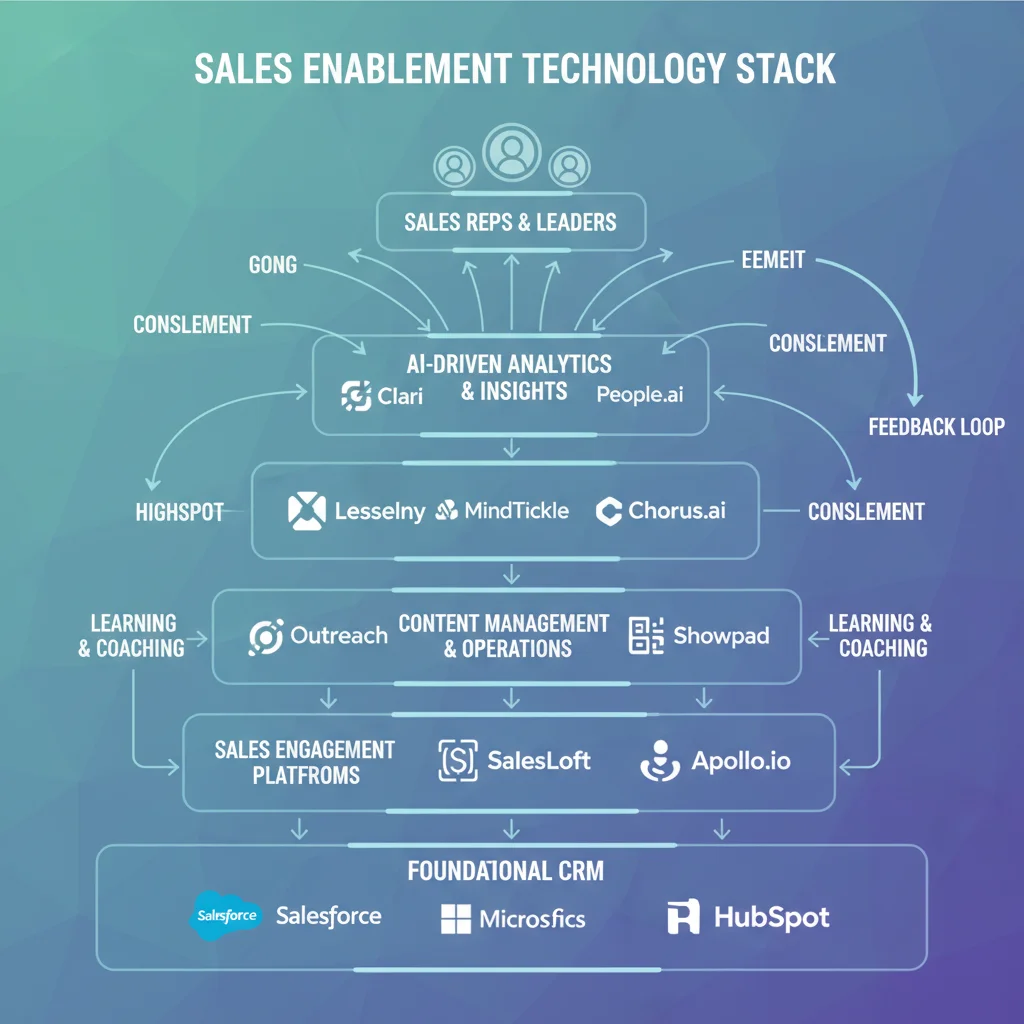
While the specific tools may vary based on industry, company size, and sales model, most effective Sales Enablement Stacks share several key categories:
- Customer Relationship Management (CRM) Systems: The bedrock of any sales operation. CRM platforms like Salesforce, HubSpot, or Microsoft Dynamics 365 manage customer data, track interactions, and provide a holistic view of the sales pipeline. They are the central nervous system for sales activities.
- Content Management Systems (CMS) & Sales Content Platforms: These tools (e.g., Highspot, Seismic, Showpad) ensure sales teams can easily find, customize, and deliver relevant content (presentations, case studies, whitepapers) to prospects. They often include analytics to track content performance.
- Sales Training & Coaching Platforms: Facilitate ongoing education, skill development, and performance coaching. This can include learning management systems (LMS), virtual role-play tools, and platforms for recording and analyzing sales calls.
- Sales Engagement Platforms (SEPs): Tools like Salesloft, Outreach, or Groove automate and streamline sales outreach activities across multiple channels (email, phone, social media). They help reps manage sequences, track engagement, and personalize communications at scale.
- Sales Intelligence Tools: Provide valuable insights into prospects and accounts, including contact information, company news, technology usage, and intent data (e.g., ZoomInfo, Lusha, Clearbit).
- Conversation Intelligence Platforms: Analyze sales calls and meetings to identify key trends, coaching opportunities, and buyer sentiment (e.g., Gong, Chorus.ai).
- Proposal & Contract Management Software: Streamlines the creation, delivery, and signing of proposals and contracts (e.g., DocuSign, PandaDoc).
- Analytics & Reporting Tools: Beyond native CRM reporting, dedicated analytics platforms can provide deeper insights into sales performance, pipeline health, and forecasting accuracy.
An honest assessment of your current tools, their utilization rates, and the pain points they address (or fail to address) is the first step towards building a truly optimized stack for 2026.
Strategic Alignment: Building Your 2026 Sales Enablement Stacks
Building a future-proof sales enablement stack isn’t about buying the latest shiny objects; it’s about strategic alignment with your business goals, sales process, and buyer journey. By 2026, the sales landscape will be even more buyer-centric, data-driven, and reliant on seamless digital experiences. Your Sales Enablement Stacks must reflect this reality.
Defining Your Sales Enablement Strategy
Before selecting any tool, clearly define your sales enablement strategy. What are your key objectives? Do you aim to increase sales productivity, improve conversion rates, shorten sales cycles, or enhance customer retention? Your technology choices should directly support these strategic goals.
Mapping Technology to the Buyer Journey
Consider the entire buyer journey, from initial awareness to post-purchase support. Which stages are currently bottlenecks? Where do your sales reps struggle to provide value or access necessary information? Your Sales Enablement Stacks should provide solutions at each touchpoint:
- Awareness/Discovery: Sales intelligence, content platforms for initial outreach.
- Consideration/Evaluation: Content platforms for detailed product information, CRM for tracking interactions, sales engagement for follow-up.
- Decision/Purchase: Proposal software, CRM for deal management, conversation intelligence for objection handling insights.
- Post-Purchase/Advocacy: CRM for customer success tracking, content platforms for onboarding materials.
Prioritizing Integration and Data Flow
The true power of a sales enablement stack lies in its integration. Data silos are the enemy of efficiency. By 2026, seamless data flow between your CRM, content platforms, engagement tools, and analytics will be non-negotiable. Look for tools with robust APIs and existing integrations to minimize manual data entry and ensure a single source of truth. This interconnectedness allows for deeper insights, better personalization, and a more streamlined workflow for your sales team.
Key Technologies Shaping 2026 Sales Enablement Stacks
As we gaze into the future, several technological advancements are poised to redefine and enhance Sales Enablement Stacks. Embracing these innovations will be crucial for maintaining a competitive edge.
Artificial Intelligence (AI) and Machine Learning (ML)
AI and ML are already transforming sales, and their impact will only grow by 2026. Expect to see AI embedded across virtually every component of your stack:
- AI-powered Sales Coaching: Providing real-time feedback during calls, suggesting optimal responses, and identifying areas for improvement based on historical data.
- Predictive Analytics: More sophisticated forecasting, identifying accounts most likely to convert, and predicting churn risk.
- Content Personalization: AI-driven content recommendations for specific buyer personas and stages of the sales cycle.
- Automated Lead Scoring and Prioritization: AI algorithms will refine lead qualification, ensuring reps focus on the highest-potential prospects.
- Generative AI for Content Creation: Assisting in drafting personalized emails, proposals, and even presentation slides, significantly reducing content creation time.
Advanced Analytics and Business Intelligence
Beyond basic reporting, 2026 Sales Enablement Stacks will leverage advanced analytics to provide deeper, more actionable insights. This includes:
- Attribution Modeling: Understanding the true impact of different sales activities and content on deal progression.
- Behavioral Analytics: Tracking buyer engagement with content and communications to tailor follow-ups more effectively.
- Performance Benchmarking: Comparing sales team performance against industry averages and internal best practices.
Hyper-Personalization at Scale
Buyers expect personalized experiences. By 2026, technology will enable hyper-personalization across all sales touchpoints, from initial outreach to post-sale support. This means leveraging data from CRM, sales intelligence, and engagement platforms to craft messages and content that resonate deeply with individual prospects, at scale.
Integrated Learning and Development Tools
Continuous learning is vital. Future Sales Enablement Stacks will feature more integrated learning modules, microlearning opportunities, and adaptive training paths that respond to individual salesperson performance and skill gaps, often powered by AI.
Optimizing Your Sales Enablement Stacks for Peak Performance
Once you have a strategic vision and have identified key technologies, the ongoing optimization of your Sales Enablement Stacks is crucial. This is not a one-time project but a continuous process of refinement and adaptation.
User Adoption and Training
The most sophisticated tools are useless if your sales team doesn’t use them effectively. Prioritize robust training programs, provide ongoing support, and clearly communicate the ‘why’ behind each tool. Showcase how these tools simplify their work, improve their performance, and ultimately lead to more success. Gamification and internal champions can significantly boost adoption rates.
Streamlining Workflows
Regularly review your sales workflows to identify redundancies or inefficiencies introduced by your stack. Can certain tasks be automated? Are there too many clicks required for a common action? The goal is to make the sales process as smooth and intuitive as possible for your reps.
Measuring ROI and Impact
Crucially, track the return on investment (ROI) of each component in your Sales Enablement Stacks. Are your content platforms leading to higher engagement? Is your sales engagement platform increasing meeting bookings? Use key performance indicators (KPIs) such as:
- Sales cycle length
- Win rates
- Average deal size
- Sales productivity (e.g., calls per day, emails sent)
- Content utilization and engagement
- Sales rep ramp-up time
- Quota attainment
By continuously measuring and analyzing these metrics, you can make data-driven decisions about which tools to keep, optimize, or replace.

Challenges and Considerations for 2026
While the benefits of a well-optimized sales enablement stack are clear, organizations must also be mindful of potential challenges as they build towards 2026.
Vendor Sprawl and Integration Complexity
The sheer number of sales tech vendors can be overwhelming. Without a clear strategy, companies risk accumulating too many disparate tools, leading to integration nightmares, increased costs, and confused users. A thoughtful approach to vendor selection, prioritizing platforms that offer comprehensive suites or seamless integrations, is vital.
Data Security and Privacy
As more data flows through your Sales Enablement Stacks, data security and privacy become paramount. Ensure all chosen tools comply with relevant regulations (e.g., GDPR, CCPA) and have robust security measures in place. Training your sales team on data handling best practices is also critical.
Cost Management
The cost of building and maintaining a cutting-edge sales enablement stack can be substantial. It’s essential to conduct a thorough cost-benefit analysis for each tool and continuously evaluate its value. Consider subscription models, scalability, and the total cost of ownership.
Change Management
Introducing new technologies or overhauling existing ones requires careful change management. Sales teams can be resistant to change, especially if they perceive new tools as adding complexity rather than value. Clear communication, strong leadership buy-in, and emphasizing the benefits for the individual salesperson are key to successful adoption.
The Future of Sales Enablement Stacks: Beyond 2026
Looking beyond 2026, the evolution of Sales Enablement Stacks will likely continue at an accelerated pace. We can anticipate:
- Even Deeper AI Integration: AI will move from assisting to proactively guiding sales interactions, potentially even automating entire segments of the sales process for simpler transactions.
- Virtual and Augmented Reality (VR/AR) for Training & Demos: Immersive technologies could revolutionize sales training and product demonstrations, offering highly interactive and realistic experiences.
- Greater Emphasis on Ethical AI: As AI becomes more pervasive, ensuring fairness, transparency, and ethical use of AI in sales will be a critical focus.
- Truly Unified Platforms: The trend towards fewer, more comprehensive platforms that integrate multiple functionalities will intensify, reducing vendor sprawl and simplifying the tech landscape.
- Hyper-Personalized Buyer Experiences: Expect even more sophisticated tools that allow for real-time, dynamic adjustments to sales content and messaging based on immediate buyer behavior and preferences.
The goal remains constant: to empower sales teams to be as effective and efficient as possible, providing exceptional value to buyers and driving sustainable business growth. The tools and technologies will continue to evolve, but the strategic imperative to invest in and optimize your Sales Enablement Stacks will only grow stronger.
Conclusion: Your Competitive Edge in 2026 and Beyond
Mastering your Sales Enablement Stacks is not just about adopting new technology; it’s about strategically empowering your sales force to thrive in an increasingly competitive and complex market. By 2026, organizations with well-integrated, AI-powered, and user-friendly stacks will possess a distinct competitive advantage. They will be able to accelerate sales cycles, improve win rates, enhance customer satisfaction, and ultimately, drive superior revenue growth.
The journey to an optimized sales enablement stack begins with a clear understanding of your current state, a strategic vision aligned with your business goals, and a commitment to continuous evaluation and improvement. Embrace the technological advancements, prioritize seamless integration, and always keep the end-user—your sales team—at the forefront of your decisions. The future of sales belongs to those who are prepared to equip their teams with the best possible tools, enabling them to connect, engage, and convert with unparalleled efficiency and effectiveness. Start building and refining your 2026 sales enablement advantage today.